In modern electronic warfare systems, the electromagnetic environment is constantly changing, with a wide variety of threat signals, complex spectrums, and extremely short occurrence times. As core RF front-end equipment, power amplifier equipment not only needs to output high-power microwave signals but also must possess excellent rapid response capabilities and robust anti-jamming performance to support the efficient execution of tactical tasks such as jamming suppression and deception. Power amplifier equipment integrates multiple key technologies to build a comprehensive capability system with high reliability, high intelligence, and high adaptability.1. ALC Gain Control Function: Achieving Dynamic Stability of Output PowerIn electronic warfare scenarios, the input signal strength often fluctuates drastically due to distance, switching of interference sources, or tactical adjustments. To ensure that the output power remains within a set threshold and to avoid overdrive damage to downstream components or signal distortion, power amplifier equipment integrates an automatic level control function. This technology samples the output signal in real time and dynamically adjusts the pre-amplifier gain, completing closed-loop feedback within milliseconds to maintain a high degree of output power stability. This capability is crucial for precisely controlling interference energy, preventing friendly fire incidents, and meeting electromagnetic spectrum management requirements.
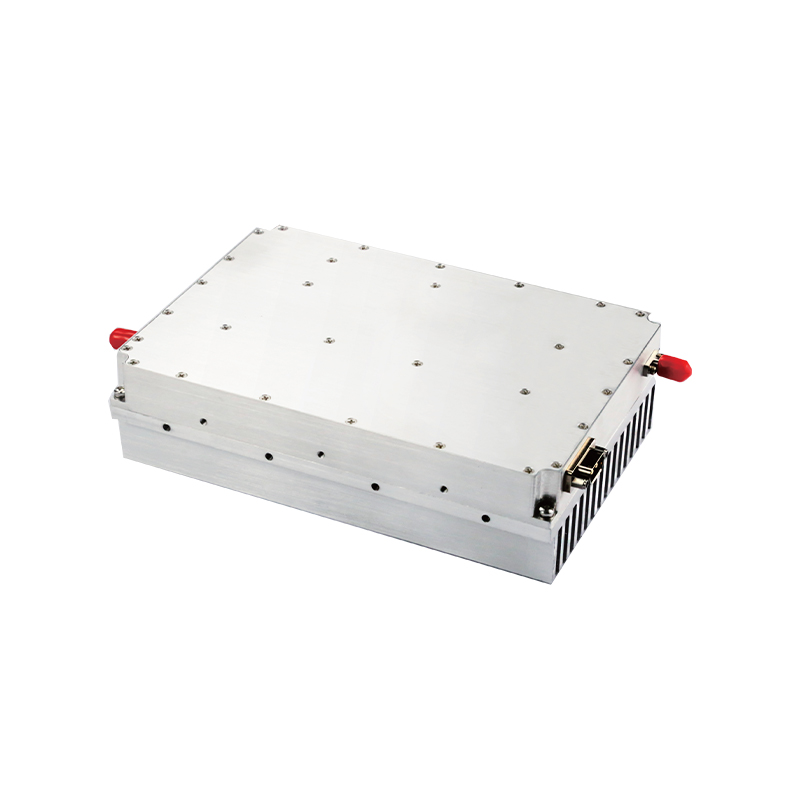
2. Multiple Status Detection Mechanisms: Ensuring Transparent and Controllable System OperationTo enhance maintainability and mission continuity in battlefield environments, the equipment incorporates comprehensive status monitoring functions. These include real-time acquisition of operating voltage and current to assess power supply health; online monitoring of output signal power and VSWR to promptly detect antenna mismatch or feeder faults; and the creation of a multi-dimensional operational profile by combining temperature sensor data. This information is not only used for local protection logic triggering but can also be uploaded to the command and control system via a communication interface for remote status awareness and fault prediction.3. Dual Overheat and Overload Protection: Ensuring Survivability Under Extreme ConditionsElectronic warfare missions often require power amplifier equipment to operate at full or even overload for extended periods, which can easily lead to heat accumulation or reflected power surges caused by impedance mismatch. To address this, the equipment is designed with an intelligent overheat protection mechanism—automatically derating or shutting down the output when the cooling system cannot maintain a safe junction temperature; simultaneously, it is equipped with a high-speed overload detection circuit that cuts off the excitation signal within microseconds when encountering severe standing waves or short circuits at the output, preventing permanent damage to the power amplifier tubes. This "hardware and software combined" protection strategy greatly enhances the equipment's battlefield survivability in high-intensity electromagnetic warfare.4. Serial Communication and Ethernet Dual-Mode Interface: Supporting Flexible Networking and Remote ControlModern electronic warfare systems emphasize networked collaboration and centralized control. This power amplifier equipment provides both RS422/485 serial communication interfaces and a standard Ethernet interface, compatible with various host computer protocols. Operators can read equipment parameters, modify operating modes, start/stop amplifiers, or retrieve historical alarm records in real time through a local control panel or a remote command and control center. This dual-channel communication architecture meets the needs of simple deployment in field environments and also supports information integration at fixed sites, enhancing the overall flexibility of the system.5. Balanced Amplification and Synthesis Technology: Enhancing Reliability and RobustnessUtilizing a balanced amplification structure, the input signal is split into two orthogonal sub-signals, each independently amplified before being synthesized into an output. This technology not only improves the input/output VSWR and reduces the matching requirements of the pre- and post-amplifier stages, but more importantly, it possesses inherent redundancy—even if one power amplifier module fails, the other can still maintain partial output capability, preventing complete mission interruption. Combined with a high-efficiency synthesis network and high-quality component selection, the overall MTBF is significantly improved, meeting the high reliability standards of military equipment.6. Reserved Cold Backup Expansion Interface: For Future Upgrades and Redundant ConfigurationTo adapt to the long-term evolution and mission flexibility requirements of electronic warfare systems, the equipment has reserved a cold backup expansion interface at the hardware level. Users can connect an external backup power amplifier module or power synthesis unit to build an N+1 redundant architecture without replacing the main unit; it also allows for a smooth transition when upgrading to higher frequency bands or higher power modules in the future. This forward-looking design significantly extends the equipment's service life and reduces total life-cycle costs.In summary, power amplifier equipment for electronic warfare applications has evolved from a single power output unit into a highly resilient radio frequency platform integrating intelligent control, status awareness, multiple protections, and network interconnection. Its rapid response and anti-jamming capabilities are built upon features such as ALC control, comprehensive monitoring, multiple protections, advanced architecture, and expansion interfaces, providing a solid and reliable "power source" for modern electronic warfare.