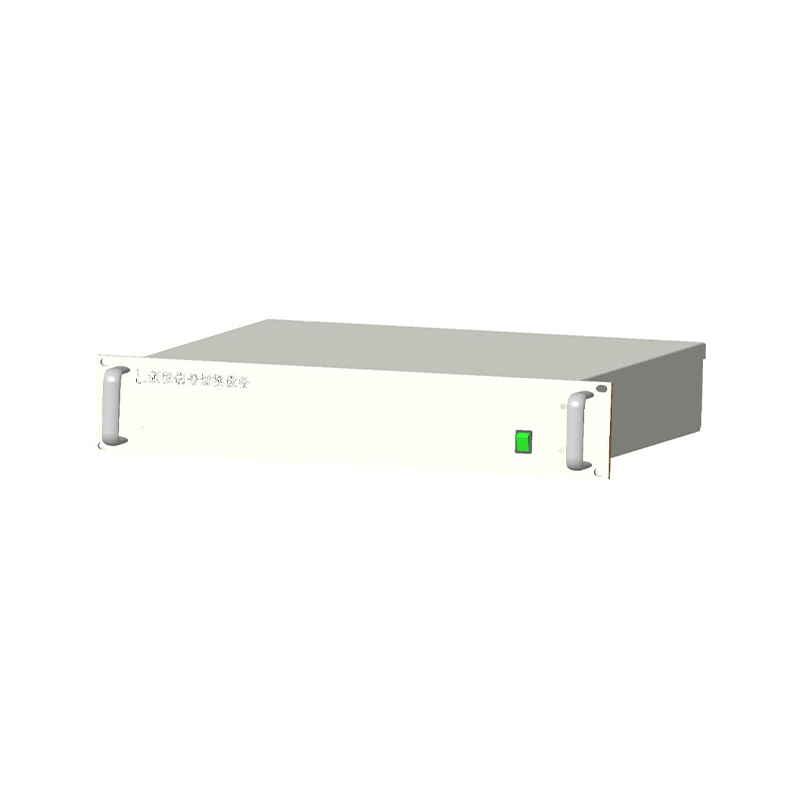
How can an L-band signal switching device achieve seamless power distribution between digital intermediate frequency (IF) and mixed analog/digital signals?
Publish Time: 2026-01-09
In modern communication, radar, satellite telemetry, tracking, and electronic warfare systems, the L-band, as a crucial radio frequency band, widely carries critical tasks such as navigation, telemetry, data links, and tactical communications. With the accelerating pace of digitization, systems not only contain traditional analog radio frequency signals but also a large number of digital intermediate frequency (IF) signals, and even complex signal streams where digital and analog signals coexist. As the core hub for signal routing and distribution, the L-band signal switching device must possess the ability to efficiently, with low distortion, and with high reliability, distribute and switch power between digital IF signals and mixed analog/digital signals.1. Mixed-Signal Compatible Architecture: Heterogeneous Signal Processing on a Unified PlatformTraditional RF switches are designed only for analog continuous wave signals and struggle to handle the wide bandwidth, high dynamic range, and discrete characteristics of digital IF signals. Modern L-band signal switching devices employ a multi-channel heterogeneous signal compatible architecture, integrating two independent but collaborative paths:High-frequency analog path: Utilizing a high-performance GaAs or PIN diode switching matrix, it supports low insertion loss and high isolation switching of L-band analog signals;Digital intermediate frequency (IF) path: Based on a high-speed ADC/DAC front-end and FPGA programmable logic, it supports routing and power distribution of digital IF signals with sampling rates up to hundreds of MS/s.Through a unified backplane bus and synchronous clock system, the two paths can operate collaboratively under the same command, ensuring that in mixed-signal scenarios, whether purely analog, purely digital, or mixed-signal inputs, they can be accurately identified, classified, processed, and allocated to the target output port as needed, achieving a "seamless connection" between the physical and logic layers.2. Intelligent Power Distribution and Dynamic Impedance MatchingAlthough digital IF signals exist in digital form, they still exhibit high-frequency current during transmission, making them extremely sensitive to impedance matching; while analog L-band signals have strict requirements for VSWR and reflection loss. To avoid signal reflection, power loss, or waveform distortion caused by impedance mismatch, this switching device incorporates an adaptive impedance matching network.When different signal types are detected, the system automatically adjusts the matching circuit parameters of the output port to maintain the port impedance near the standard value of 50 Ω. Simultaneously, through a built-in power sensor and closed-loop feedback control, the device can monitor and dynamically balance the power of each output branch in real time.3. Dual-Mode Operation and High-Reliability Switching MechanismTo adapt to complex deployment environments, this device supports both remote and local panel operation modes. In remote mode, the host computer can issue switching commands through a graphical interface, suitable for centralized monitoring centers or unattended sites. Local mode is equipped with physical buttons and knobs for easy on-site debugging and emergency operation. A hardware interlock mechanism is provided between the two modes to prevent command conflicts.More importantly, all switching actions employ a break-before-make or synchronous bumpless switching strategy. Combined with high-speed solid-state relays or MEMS switches, the switching time can be controlled at the microsecond level, effectively avoiding signal interruption or transient overshoot and ensuring the continuity of critical task links.4. Visualized Signal Connection Status: Enhancing Operational Efficiency and SecurityIn multi-input multi-output (MIMO) configurations, the connection relationships between dozens of interfaces can easily become confusing. To address this, the device innovatively introduces a function to highlight signal connections between interfaces: each front panel interface is equipped with a high-brightness LED indicator, with colors and flashing patterns corresponding to different signal types.Furthermore, some high-end models integrate an OLED screen or support a Web GUI, capable of drawing real-time signal topology diagrams and intuitively displaying connection statuses such as "Input A → Output 3+7" and "Digital Channel 2 is broadcasting." This "what you see is what you connect" visualization design greatly reduces the risk of misoperation and significantly improves the efficiency of system deployment, troubleshooting, and daily maintenance.5. Application Scenario Verification: From Telemetry and Control Stations to Mobile PlatformsIn satellite ground stations, this device can simultaneously receive L-band analog telemetry signals from the antenna and digital intermediate frequency (IF) feedback signals from the baseband processor, routing them separately to recording equipment, demodulators, and backup links, achieving efficient resource reuse. On shipborne or vehicle-mounted mobile platforms, its vibration resistance, wide temperature range, and EMC protection capabilities ensure stable completion of mixed signal switching tasks even in turbulent environments with strong electromagnetic interference.The L-band signal switching device has evolved from a single-function RF switch into a comprehensive signal management platform integrating mixed signal processing, intelligent power allocation, dual-mode control, and visual interaction. Through multi-dimensional innovation in materials, circuitry, software, and ergonomics, it has successfully solved the power allocation challenge of coexisting digital IF and analog signals, providing a solid foundation for future intelligent, networked, and highly reliable electronic systems. With the rise of new applications such as 6G and low-Earth orbit satellite internet, such devices will play an irreplaceable role in a broader spectrum space.