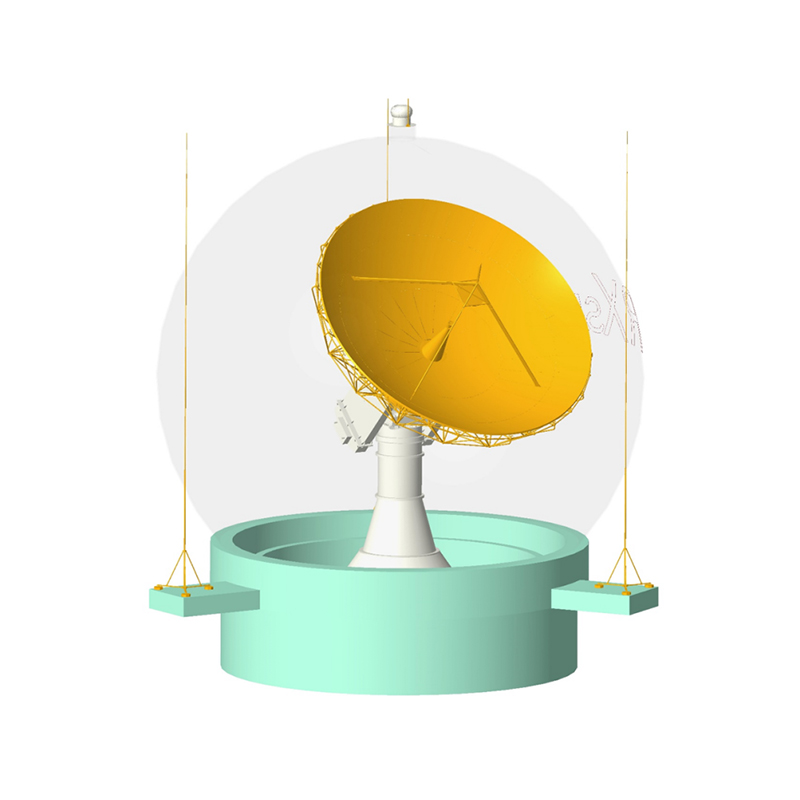
How do large-caliber fixed satellite ground stations achieve stable rotation and positioning of their ultra-large antennas through precision mechanical structures?
Publish Time: 2026-06-26
In modern satellite communication and deep space exploration systems, large-caliber fixed satellite ground stations undertake critical tasks such as signal reception, data transmission, and aerospace telemetry and control. Due to their enormous antenna aperture, complex structure, and extremely high weight, they place extremely high demands on rotational accuracy and positioning stability during operation. To ensure that the antenna maintains high-precision pointing over long periods of operation, large-caliber fixed satellite ground stations typically rely on the coordinated design of precision mechanical structures and highly reliable control systems to achieve stable rotation and precise positioning of the ultra-large antenna.1. High-rigidity structure ensures foundation stabilityLarge-aperture antennas typically employ steel structures or space truss structures to ensure sufficient overall rigidity and load-bearing capacity. In the design, by optimizing the distribution of mechanical structures, the antenna weight is evenly distributed to the supporting foundation, reducing localized stress concentration. Simultaneously, the use of high-strength materials and reinforced node designs effectively enhances the overall resistance to deformation. This high-rigidity structure is the foundation for achieving stable rotation and precise positioning, maintaining its structural shape unchanged during long-term operation.2. Precision Bearing System for Low-Friction RotationThe azimuth and elevation axes of the antenna are typically supported by large, high-precision bearing systems. Using low-friction, high-load-bearing bearings significantly reduces mechanical resistance and wear during rotation. Simultaneously, the bearing system undergoes precision machining and assembly to ensure smooth and stable rotation, avoiding positioning errors caused by gaps or eccentricity, thereby improving overall pointing accuracy.3. High-Precision Servo Drive Control SystemThe servo drive system plays a crucial role in rotation and positioning. Large-aperture ground stations are typically equipped with high-torque servo motors, combined with closed-loop control technology, to monitor and adjust the antenna's operating status in real time. Through encoder feedback of position data, the control system can fine-tune the antenna angle, achieving millimeter-level or even higher precision pointing control, ensuring the antenna is always accurately aligned with the target satellite.4. Vibration Reduction and Disturbance Resistance Structural DesignDue to the antenna's large size, it is susceptible to wind, temperature changes, and mechanical vibrations. To improve stability, ground stations typically employ vibration reduction structural designs, such as dampers, flexible connection structures, and wind-resistant truss designs. These structures effectively absorb external disturbance energy and reduce vibration transmission, thus preventing antenna misalignment or jitter during operation and ensuring long-term stable positioning.5. Precision Transmission Mechanism Improves Positioning AccuracyIn the antenna rotation system, the accuracy of the reducer and transmission mechanism directly affects the overall positioning performance. A high-precision gear reduction system enables low-speed, high-torque output, making antenna movement smoother and more controllable. Simultaneously, by eliminating backlash and employing high-precision machining processes, transmission errors can be further reduced, improving the repeatability and stability of angle positioning.6. Automatic Calibration and Real-time Monitoring SystemModern large-aperture satellite ground stations are typically equipped with automatic calibration systems. Through real-time analysis of celestial signals or satellite beacons, they automatically correct antenna pointing errors. Simultaneously, a sensor network continuously monitors antenna attitude, structural stress, and operational status. Once a deviation is detected, dynamic adjustments are made, ensuring high-precision stability during long-term operation.Large caliber fixed satellite ground stations achieve stable rotation and precise positioning of ultra-large antennas through the synergistic effect of high-rigidity structures, precision bearing systems, high-precision servo control, vibration reduction design, and precision transmission mechanisms. This multi-system collaborative engineering design not only ensures the reliable operation of the antenna in complex environments, but also provides a solid guarantee for deep space communication and satellite data reception, making it an indispensable and important component of modern aerospace communication infrastructure.