Requires no power grid, not terrain – How does the small caliber portable satellite ground terminal achieve autonomous operation across all domains?
Publish Time: 2025-12-12
In extreme or temporary mission scenarios such as information warfare, natural disaster emergency response, polar scientific expeditions, and oceanographic operations, traditional communication infrastructure often struggles to provide coverage or rapidly fails. In these situations, quickly establishing a stable and reliable space-based information link becomes crucial to the success of the operation. The small caliber portable satellite ground terminal emerged to address this need. It not only eliminates dependence on power grids and fixed terrain but also redefines the boundaries of satellite communication with its "ready-to-use, globally accessible" capabilities.1. Highly Integrated Modular Architecture: Small Size, Big CapacityOne of the core advantages of the small caliber portable satellite ground terminal lies in its miniaturized, modular, and integrated design. The entire system highly integrates key functional units such as satellite mission control, signal transmission and reception processing, communication protocol matching, and data distribution into a single, portable container that can be carried by a single person or transported by vehicle. Each module uses standardized interfaces and can be flexibly combined according to task requirements—for example, a high-bandwidth X/K band module can be used in remote sensing data reception tasks, while switching to the more interference-resistant L/S band is possible in emergency communication scenarios.This "on-demand configuration" flexibility not only significantly reduces system redundancy but also dramatically improves deployment efficiency. Users do not need to carry a full set of heavy equipment; they only need to select the corresponding task package to complete field setup within 15 minutes, truly achieving "ready to go."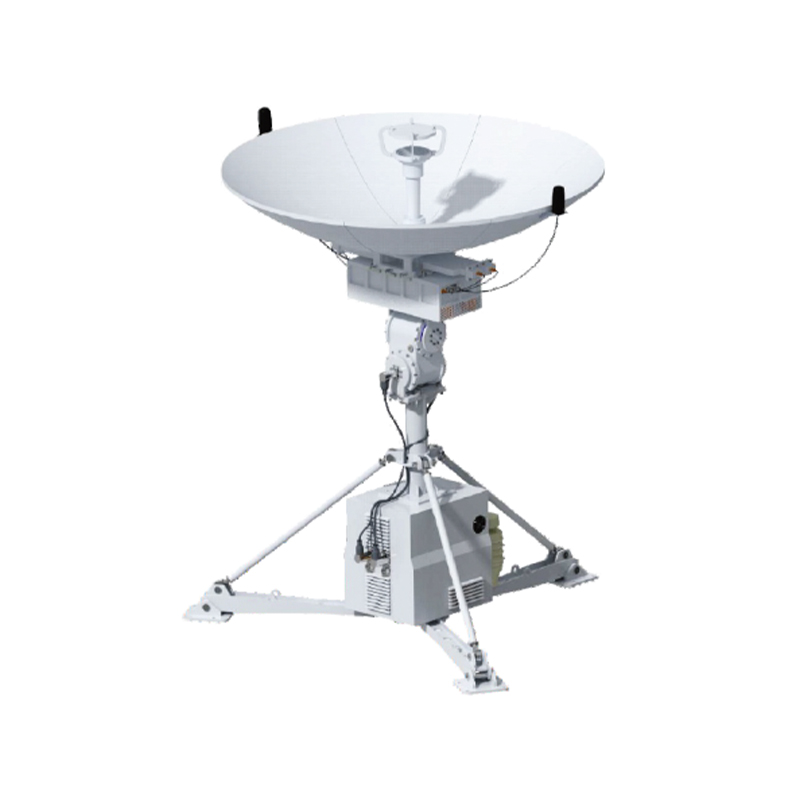
2. Multi-band Compatibility and Intelligent Communication Matching: Breaking Down the "Language Barriers" Between Multiple ConstellationsCurrently, low-Earth orbit satellite constellations are diverse, with different systems using multiple frequency bands such as L, S, C, X, and K, and varying communication protocols. If the terminal only supports a single frequency band or requires manual parameter switching, it will severely restrict response speed and compatibility.This portable terminal, through its built-in multi-band RF front-end and intelligent communication engine, can automatically identify the orbital parameters, modulation methods, and communication protocols of the access satellites and complete the optimal link configuration within seconds. Whether it's Starlink, OneWeb, or domestically developed low-Earth orbit (LEO) constellations like "Hongyan" and "Hongyun," the terminal can seamlessly connect. This "rapid and automatic matching of communication modes" capability makes it a truly "universal space-based interface," greatly expanding the breadth and depth of application scenarios.3. High-Precision Autonomous Servo System: "Top-to-Top" Tracking with 0.03-Degree Pointing AccuracyLow-Earth orbit (LEO) satellites fly at high speeds and have short transit times, placing extremely high demands on the tracking accuracy of ground terminals. Traditional large ground stations rely on precision mechanical structures and external calibration, making rapid deployment in the field difficult.However, this terminal is equipped with a self-developed high-precision LEO spacecraft tracking servo system, combining inertial navigation, GNSS positioning, and ephemeris prediction algorithms to achieve three core functions: automatic north-finding, automatic time synchronization, and automatic positioning. Even in deserts or at sea without network or base stations, the system can quickly complete self-calibration after power-on and perform continuous "top-to-top" tracking of high-speed moving low-Earth orbit satellites with an antenna pointing accuracy better than 0.03 degrees—meaning the antenna is always precisely aligned with the satellite's overhead trajectory, maximizing the communication window and data throughput.4. Energy Self-sufficiency and Environmental Adaptability: Completely Free from Grid Constraints"No external power supply required" is a key prerequisite for its fully autonomous operation. The terminal has a built-in high-energy-density lithium battery pack, coupled with an efficient power management module, allowing it to operate continuously for 6–12 hours on a full charge, meeting the needs of typical mission cycles. It also supports multiple power replenishment methods such as solar power and vehicle-mounted power supplies, further extending its field endurance.Furthermore, the entire unit adopts an IP65 or higher protection rating, enabling stable operation in harsh environments such as -40℃ to +65℃ temperatures, strong winds, sandstorms, and high humidity salt spray. No level foundation or fixed support is required; a tripod or simple platform is sufficient for deployment, truly achieving "ready to use immediately upon deployment."5. Intelligent Human-Machine Interaction and Situational Awareness Integration: Making Operation "Zero-Threshold"Despite its technical complexity, the terminal's user interface is extremely user-friendly. The system provides two-dimensional/three-dimensional dynamic situational awareness display, presenting key information such as satellite orbit, link status, data traffic, and antenna pointing in real time. Mission personnel can remotely control the system via touchscreen or tablet, and even set automated task processes—such as "automatic wake-up during satellite overpass—link establishment—receiving remote sensing data—encrypted data transmission."This highly automated interaction logic significantly reduces the professional background requirements for operators, enabling rescue team members, scientific expedition members, or frontline soldiers without communications expertise to quickly get started, truly "deploying" space-based capabilities to the frontline.The emergence of the small caliber portable satellite ground terminal signifies that space-based information acquisition and transmission is evolving from "centralized and fixed" to "distributed and mobile." It no longer requires massive infrastructure support, but instead condenses complete telemetry, control, communication, and data processing capabilities into a portable system. With its modular design, multi-frequency compatibility, high-precision tracking, energy self-sufficiency, and intelligent interaction, it truly achieves autonomous operation capability across all regions without the need for a power grid or terrain.