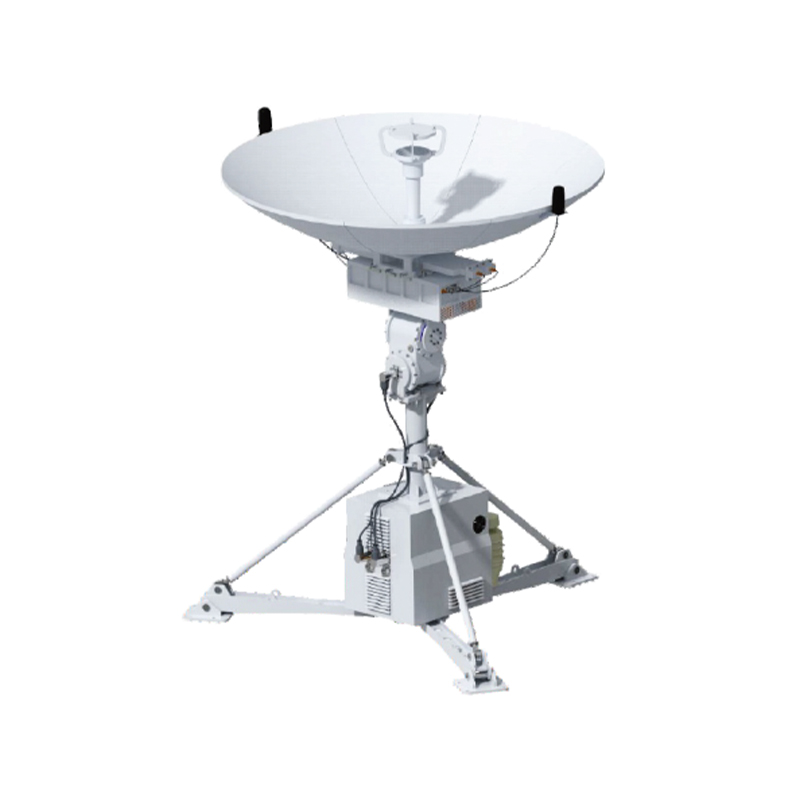
As a fast and flexible space-based information support system, the small caliber portable satellite ground terminal plays a crucial role in modern satellite communication, remote sensing data reception, and satellite mission control. Its greatest advantage lies in its small size, portability, and ability to operate independently in complex environments, enabling rapid deployment and efficient startup. Ensuring the terminal's rapid deployment and stable operation in different environments is a key consideration during design and use.1. Modular Design for Convenient DeploymentPortable satellite ground terminals typically employ a modular design, integrating the antenna, tracking servo system, communication processing unit, power module, and control software into a single package, while also supporting disassembly and reassembly. The advantage of modular design is that users can quickly assemble or disassemble the equipment according to environmental conditions and mission requirements, significantly shortening deployment time. For example, in complex terrain in the field, operators only need to quickly connect the antenna and control unit according to the modular interface to complete the basic configuration, avoiding the cumbersome installation and debugging process of traditional ground stations.2. High-Precision Servo Tracking System Ensures Rapid Lock-OnIn rapid deployment, rapid locking of the satellite signal is a critical step. Portable terminals are typically equipped with a self-developed high-precision servo tracking system for low-Earth orbit spacecraft, enabling automatic calibration and rapid positioning in environments with varying latitudes, terrain undulations, and mobile platforms. The servo system automatically adjusts the antenna elevation and azimuth angles by calculating satellite orbit parameters in real time, allowing the terminal to acquire and track satellite signals quickly. Whether in mountainous, maritime, or desert environments, this system ensures the terminal can rapidly lock onto target satellites, improving startup efficiency.
3. Intelligent Control and Automated OperationSmall portable terminals are designed with intelligent operation in mind, supporting one-button or semi-automatic startup modes. Through built-in task control software, the system can automatically select the communication mode, adjust antenna parameters, and initialize the signal transmission and reception link based on the current environment and satellite type. Automated operation not only reduces manual intervention but also significantly lowers operational complexity, allowing even non-professionals to quickly complete deployment and startup. Furthermore, the intelligent control system can monitor the status of each module in real time, automatically alarming upon detecting anomalies, improving system reliability.4. Energy and Temperature Management Adaptable to Different EnvironmentsWhen operating independently in the field, the terminal does not rely on an external power source; therefore, energy management is crucial. High-performance lithium iron phosphate batteries or rechargeable energy modules provide long-term stable power support for the system, while combined with solar panels or portable power generation devices, enabling continuous operation. In high or low temperature environments, the terminal's temperature control system can heat or regulate the heat dissipation of core electronic equipment, ensuring that each module reaches its optimal operating state upon startup. Effective energy and temperature control management allows the terminal to start up efficiently even in extreme environments.5. Environmental Adaptability and Structural OptimizationTo adapt to complex terrains such as deserts, rainforests, and islands, the portable terminal adopts a design that balances lightweighting and robustness. For example, wind-resistant, rain-resistant, and corrosion-resistant shell materials, as well as a foldable or retractable antenna structure, enable the equipment to be quickly deployed and operate stably in harsh environments. Furthermore, vibration-resistant design and dustproof measures ensure that the terminal is not damaged during transportation, loading, unloading, and rapid deployment, improving overall reliability.The small caliber portable satellite ground terminal's ability to achieve rapid deployment and efficient startup in various environments relies on the synergistic effect of modular design, high-precision servo tracking, intelligent control, energy management, and environmental adaptability optimization. Modular design shortens assembly time, servo tracking system ensures rapid signal locking, intelligent control reduces operational difficulty, energy and temperature control guarantee stable power supply, and structural optimization enhances environmental adaptability. These factors work together to enable the portable terminal to quickly start up in complex and variable field environments, providing reliable support for satellite communication, remote sensing data reception, and mission control.